
The Rise of AI-Assisted Revenue Management: Practical Steps for Hotels in 2026

This blog explores how AI is reshaping revenue management and, most importantly, how hotels can adopt these tools in a practical, realistic way regardless of size, brand, or technology maturity.
Revenue management (RM) has always been a balance of art and science. But 2026 marks a turning point: the shift from traditional, manual forecasting to AI-assisted, data-driven decision-making that enhances, not replaces, the expertise of revenue leaders.
Hotels that embrace this hybrid model gain a real competitive advantage: better accuracy, faster responses to market changes, and more time for commercial strategy.

Why AI Matters Now More Than Ever
The last few years have brought unprecedented volatility: unstable demand patterns, staffing shortages, inflation, shifts in traveler behavior, and rapid changes in distribution. Traditional forecasting methods can’t keep up with these dynamics.
AI tools excel where humans struggle:
Processing millions of data points in seconds
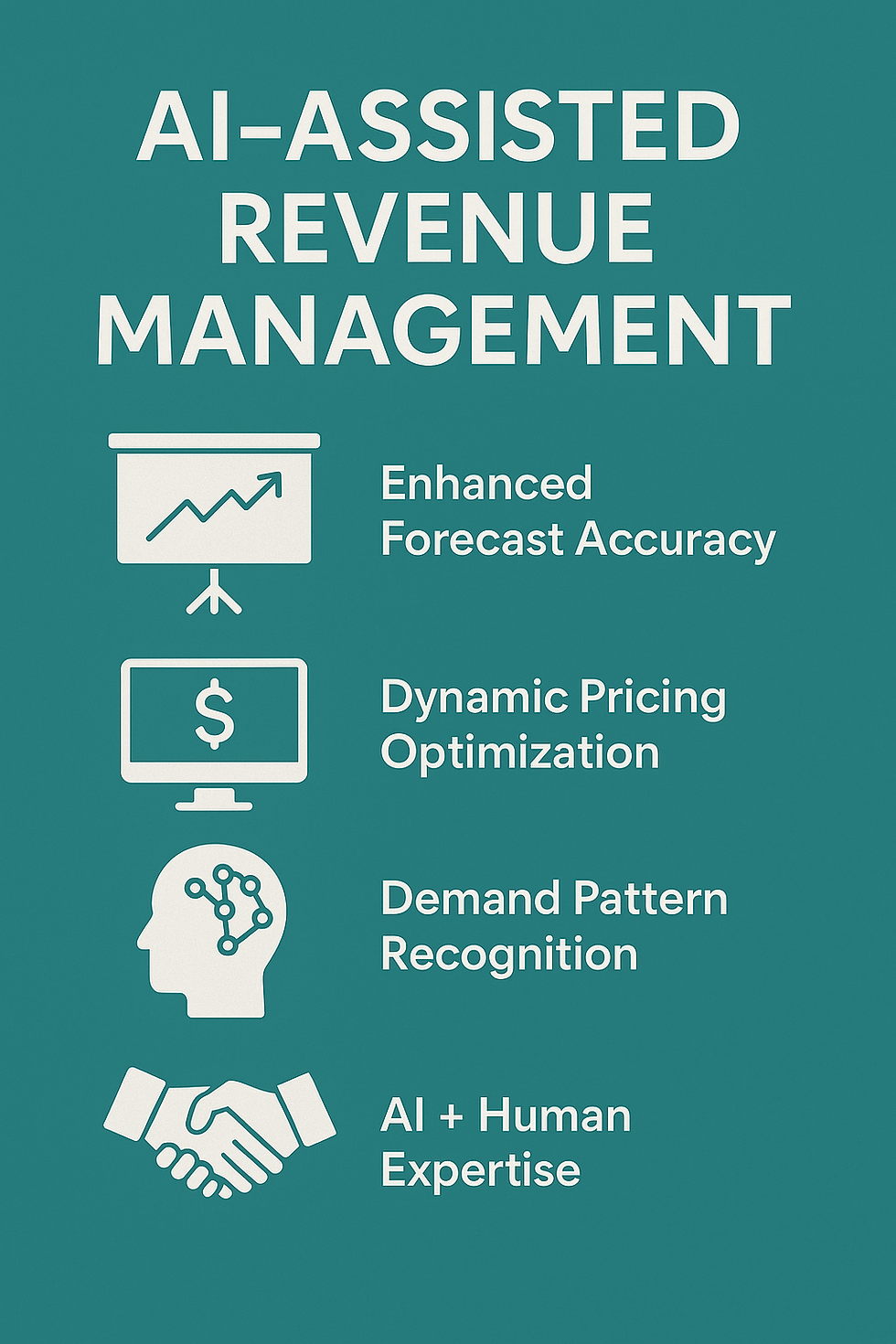
Recognizing patterns that are not obvious to analysts
Continuously learning from new bookings, cancellations, events, and market signals- Recommending dynamic actions quickly.
In 2025, hotels are no longer asking “Should we use AI?” but rather “How do we use it well without losing control?”
The right approach is AI-assisted revenue management: a model where technology supports human judgment, not the other way around. Humans still oversee strategy, market positioning, commercial alignment, leadership conversations and exceptional business decisions.
What AI-Assisted Revenue Management Actually Means
AI-assisted RM is not about letting a system “do everything.” It’s about empowering revenue leaders with stronger, faster insights.
AI can support revenue managers by:
Improving forecast accuracy through advanced machine learning
Detecting anomalies such as unusual spikes/drops in demand
Recommending price adjustments based on real-time patterns
Anticipating pickup curves more precisely
Automating repetitive tasks- Optimizing total revenue, not just rooms
Common Misconceptions About AI in Revenue Management
Misconception 1: “AI replaces revenue managers.”
Reality: AI handles analysis; people handle strategy, communication, and decision-making.
Misconception 2: “Only big brands can afford AI.”
Today’s solutions offer modular pricing, lightweight integrations, and scalable features.....even for 50-room hotels.
Misconception 3: “AI pricing is risky.”
AI is only as risky as the guardrails you set: pricing floors, fences, restrictions, and review processes still apply.
Misconception 4: “We need perfect data.”
No hotel has perfect data. AI systems are designed to work with imperfect, real-world conditions.
Practical Steps to Adopt AI-Assisted Revenue Management in 2025
Step 1: Start With a Data Audit and Evaluate PMS data health: in regards to segmentation accuracy, duplicate rates and restriction logic.
Step 2: Identify One Area for AI Support: Forecasting, pricing recommendations, market intelligence, upsell automation, or competitor monitoring.
Step 3: Build Human Guardrails: Price limits, approval workflows, displacement thresholds, and override protocols.
Step 4: Focus on “Decision Speed,” Not Just Accuracy: AI helps revenue teams react hours or days earlier to demand shifts.
Step 5: Reinvest Time Into High-Value Strategy: Total revenue management, group evaluation, cross-department alignment, forecast communication, and long‑term positioning.
Real Impact: What Hotels Gain From AI-Assisted RM
- Better forecast accuracy

- Higher ADR & RevPAR
- Improved collaboration- Increased efficiency
- More resilience during volatility
Independent hotels, mid-size properties, luxury hotels, resorts, and urban properties all gain measurable advantages. AI will not replace revenue managers in 2025, but it will elevate them. Hotels that embrace early adoption, strong data foundations, and hybrid decision models will lead the next era of commercial performance.
Final Thought
AI-assisted revenue management isn’t about technology, it’s about empowering commercial leaders to act with clarity, speed, and strategic focus. If your property hasn’t explored AI yet, 2026 is the year to begin.


Comments